Intelligent Content Plans
Overview
Content planning at scale is a coordination problem. Account teams know the client. Content teams know how to write. But the gap between “we need 12 articles for this customer” and “here are 12 approved, on-brand articles ready for production” is filled with back-and-forth, misaligned briefs, and inconsistent output.
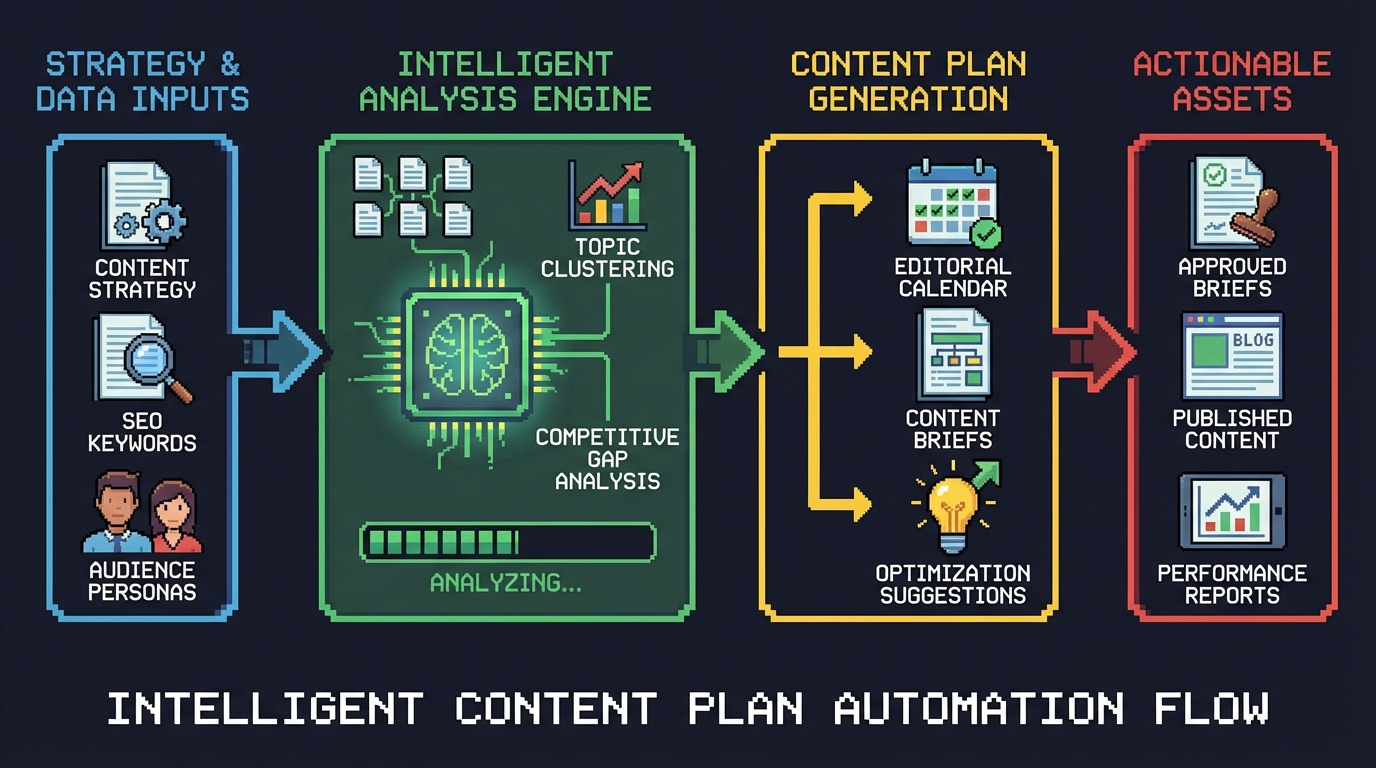
We built Intelligent Content Plans — a custom AI web app that gives account and content staff a guided workflow for producing complete content plans. The tool enforces structure at every step: define the customer profile, generate targeted ideas, configure each article’s tone and format, then review, edit, and approve before transmitting to the content team’s production queue in Notion.
Approach
The app is built with Google AI Studio and deployed on Google Cloud Run as a lightweight web application. The workflow is intentionally strict — each step must be completed before the next unlocks.
Step 1 — Content Intelligence Profile. The user starts by defining a detailed, customer-specific profile that governs all downstream generation. This is a structured JSON configuration that captures the client’s business overview, target audience and verticals, tone of voice, narrative perspective, default article length, preferred article openings and closings, language and phrasing to avoid, recommended research sources, and SEO preferences. For example, a profile might specify third-person perspective, short-form articles that open with a thought-provoking question and close with a value reinforcement statement — while explicitly avoiding jargon like “synergy” or “paradigm shift.” This profile becomes the foundation for every piece of content the tool generates.
Step 2 — Content idea generation. With the profile locked in, the user writes a highly specific prompt describing the content themes they need. The system generates a set of article ideas — up to 12 per plan — grounded in the profile’s audience, tone, and strategic context. Users select which ideas to pursue.
Step 3 — Article configuration. For each selected idea, the user can fine-tune individual settings: how the article should start and end, narrative tone of voice, point of view, and target length. They can also attach an optional anecdote to give the piece a human angle or client-specific detail that the AI weaves into the draft.
Step 4 — Generation and review. The system produces full article drafts in markdown. Users review each article inline and can edit text manually, prompt the AI for specific changes, or approve the article as-is. Approved articles trigger a second generation pass that produces supporting SEO metadata, image recommendations, and social media post variations.
Step 5 — Transmit to production. Approved articles and their supporting assets are sent via n8n to a Notion database called the AI Content Inbox. Each article lands as a task assigned to the content team, complete with the full draft, SEO data, and social outputs — ready for final polish and publishing.
Results
Structured output replaced unstructured briefs. The Content Intelligence Profile eliminated the most common failure point in content production — vague or inconsistent direction. Every article generated from a profile inherits the same strategic guardrails, tone rules, and audience targeting without the content team having to interpret a brief.
Plans that used to take days now take a single session. A 12-article content plan — from profile creation through approved drafts with SEO and social outputs — can be completed in one sitting. The strict workflow prevents scope creep and keeps the user moving forward.
Content quality improved through constraint. By forcing users to define what to avoid (clichés, jargon, aggressive sales language) and what to include (specific sources, narrative structure, opening and closing patterns), the generated content arrived closer to publishable quality on the first pass.
Seamless handoff to the content team. The n8n-to-Notion pipeline means approved content appears directly in the team’s production queue with all supporting materials attached. No email threads, no shared drives, no lost context.
Lessons Learned
-
Profiles are more powerful than prompts. A one-time, well-structured customer profile produces better results across dozens of articles than individually crafted prompts ever could. The upfront investment in defining tone, audience, and constraints pays compounding returns.
-
Strict workflows prevent AI misuse. By locking users into a sequential process — profile, then ideas, then configuration, then generation — the tool prevents the common pattern of jumping straight to “generate me an article” with no strategic foundation.
-
Let users edit at the right moment. Offering manual editing and prompt-based revision at the review stage — after generation but before approval — gave users control without letting them derail the structured workflow earlier in the process.
-
Google AI Studio is a strong prototyping-to-production path. Building the app in AI Studio and deploying via Cloud Run kept the infrastructure lightweight. The same model configuration used during prototyping runs identically in production.
-
The “transmit” step changes team behavior. Making approval an explicit, irreversible action before content enters the production queue forced users to take the review step seriously. Content quality at handoff improved significantly compared to informal sharing methods.